All Insights
Best Open-Source Glean Alternatives for Enterprise Search (2026)

By Yuhong Sun
Glean has become the default name in AI-powered enterprise search, but its $50+/user/month pricing and cloud-only deployment are pushing a growing number of teams to look for an open-source Glean alternative that delivers the same core value without the six-figure annual commitment.
If you're evaluating Glean competitors because of cost, data residency requirements, or a preference for open-source software you can audit and self-host, this guide covers the strongest alternatives available in 2026, with real pricing, trade-offs, and a total cost of ownership (TCO) comparison.
TL;DR: Glean costs $50+/user/month with no true self-hosting and no open-source code. Onyx is the strongest open-source alternative: it offers enterprise search with 40+ connectors, AI chat, agents, and deep research, all MIT-licensed and genuinely self-hostable, starting at free (community) or $20/user/month (cloud, annual billing). For teams that need data sovereignty, model flexibility, or simply can't justify Glean's price tag, Onyx is the most direct replacement. PipesHub is an emerging contender, while Elasticsearch remains an option for teams with engineering resources to build their own stack.
What Is an Open-Source Glean Alternative?
An open-source Glean alternative is an enterprise AI search platform that connects to your company's apps and documents, lets teams search and get AI-powered answers across all of them, and ships with source code you can inspect, modify, and self-host. The defining characteristics: full data sovereignty, no vendor lock-in, transparent pricing, and the ability to run on your own infrastructure or in a private cloud.
Glean is the category leader in enterprise AI search, with strong search quality and 100+ connectors. But its closed-source code, cloud-only deployment, and $50+/user/month pricing create hard blockers for a significant portion of the market: regulated industries, data-sovereign organizations, cost-constrained teams, and engineering-led companies that need to audit or extend their software. Open-source alternatives fill that gap.
What Is Onyx?
Onyx is an open-source AI platform for enterprise search, AI chat, custom agents, and deep research across company knowledge. In the context of Glean alternatives, Onyx is the option for teams that want a similar cross-app search and answer experience without giving up infrastructure control, model choice, or source-code auditability.
Onyx connects to 40+ workplace tools, inherits source permissions, supports cloud and self-hosted deployments, and can run with cloud LLMs or local models. That makes it especially relevant for buyers evaluating Glean because of cost, data residency, open-source requirements, or regulated environments.
Why Teams Are Searching for Glean Alternatives
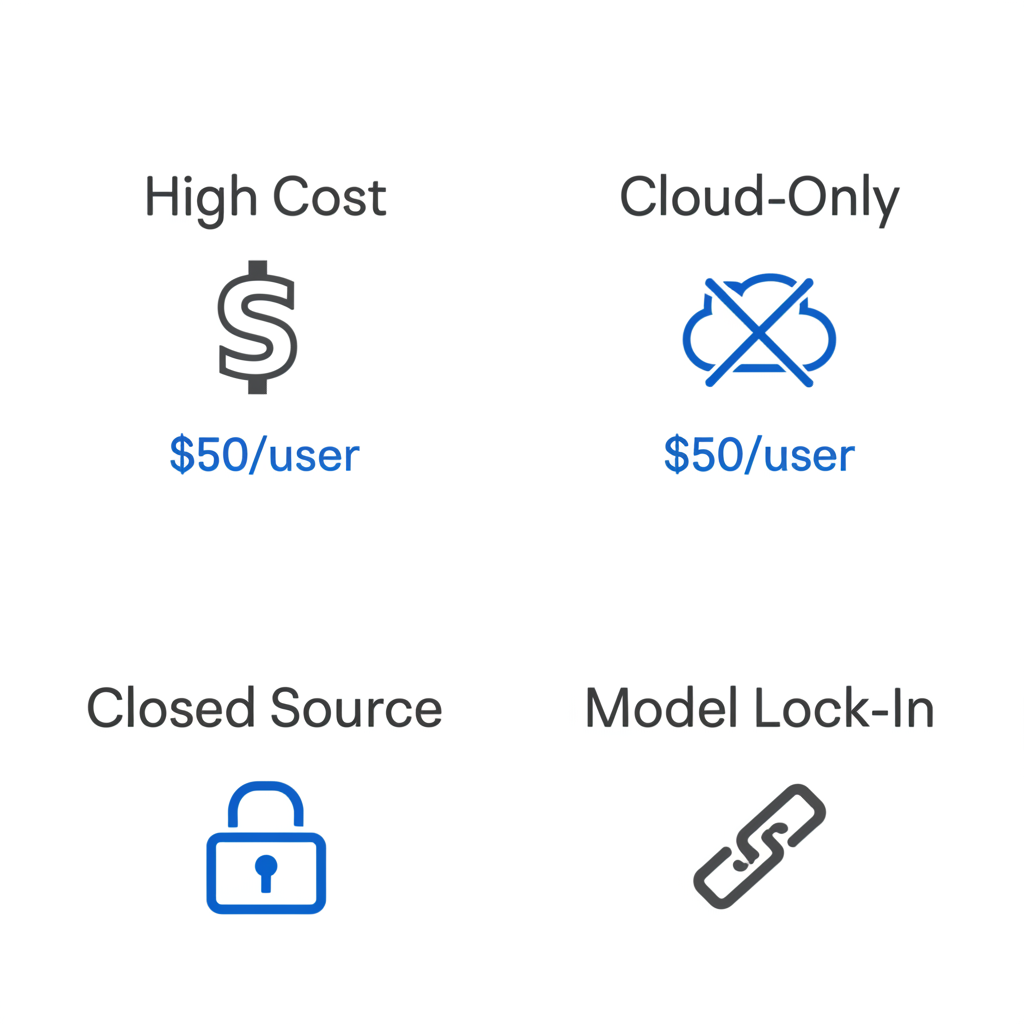
Glean does a lot of things well. It has 100+ connectors, strong search quality, and broad enterprise adoption. But four recurring pain points drive teams to evaluate alternatives:
1. Cost
Glean's pricing isn't publicly listed, but based on customer-reported data in G2 reviews and public sales disclosures, it typically runs $45-65+ per user per month, with minimum annual contracts starting at $50,000-60,000. For a 500-person organization, that translates to roughly $300K-$400K per year before implementation fees, a mandatory 10% annual support charge, and annual price escalations of 7-12% that are commonly reported in renewal contracts. Many mid-market companies simply can't justify this spend for internal search.
2. No True Self-Hosted Deployment
Glean offers a "Customer-Hosted" (cloud-prem) option, but it's not true self-hosting. Glean deploys and operates the service in an isolated VPC within your cloud environment. The infrastructure sits in your account, but Glean retains full operational control. Their documentation explicitly states they do not support manually deploying or patching Glean services, or altering any part of the architecture. You can't customize it, you can't extend it, and you can't audit the code running inside it. For organizations that need genuine control over their infrastructure (the ability to modify, restrict, or audit the software itself), Glean's cloud-prem offering doesn't qualify. It's managed SaaS in your cloud, not self-hosting.
3. No Open-Source Code
Glean's codebase is proprietary and can't be audited. For security-conscious organizations, government agencies, and teams that require code transparency before deploying software that indexes their most sensitive documents, that's a non-starter.
4. Model Lock-In
Glean controls which AI models power its features. Teams that want to use specific models (Anthropic Claude, open-source models like Llama or DeepSeek, or locally-hosted models for air-gapped environments) don't have that option.
What to Look For in a Glean Alternative
Not every "open-source" search tool is a genuine Glean replacement. A true alternative needs to match Glean on the capabilities that define enterprise search, while removing the constraints that drove you to look elsewhere.
| Capability | Why It Matters | Glean | Onyx |
|---|---|---|---|
| Native app connectors | Without connectors, you're building data pipelines yourself | 100+ | 40+ |
| Permission inheritance | Search results must respect source system access controls | Yes | Yes |
| AI chat grounded in company data | Pure search isn't enough; teams need AI answers, not just links | Yes | Yes |
| Self-hosted / on-premise | Required for regulated industries and data sovereignty mandates | No (cloud-prem only: Glean-managed, no customization or control) | Yes |
| Open-source code | Required for security audits, customization, and no lock-in | No | Yes (MIT) |
| Model flexibility | Avoid lock-in to a single LLM provider | No | Yes (100+ LLMs) |
| AI agents with tool use | Next evolution beyond search; automates multi-step workflows | Limited | Yes (MCP, OpenAPI) |
| Air-gapped deployment | Required for defense contractors (ITAR) and classified environments | No | Yes |
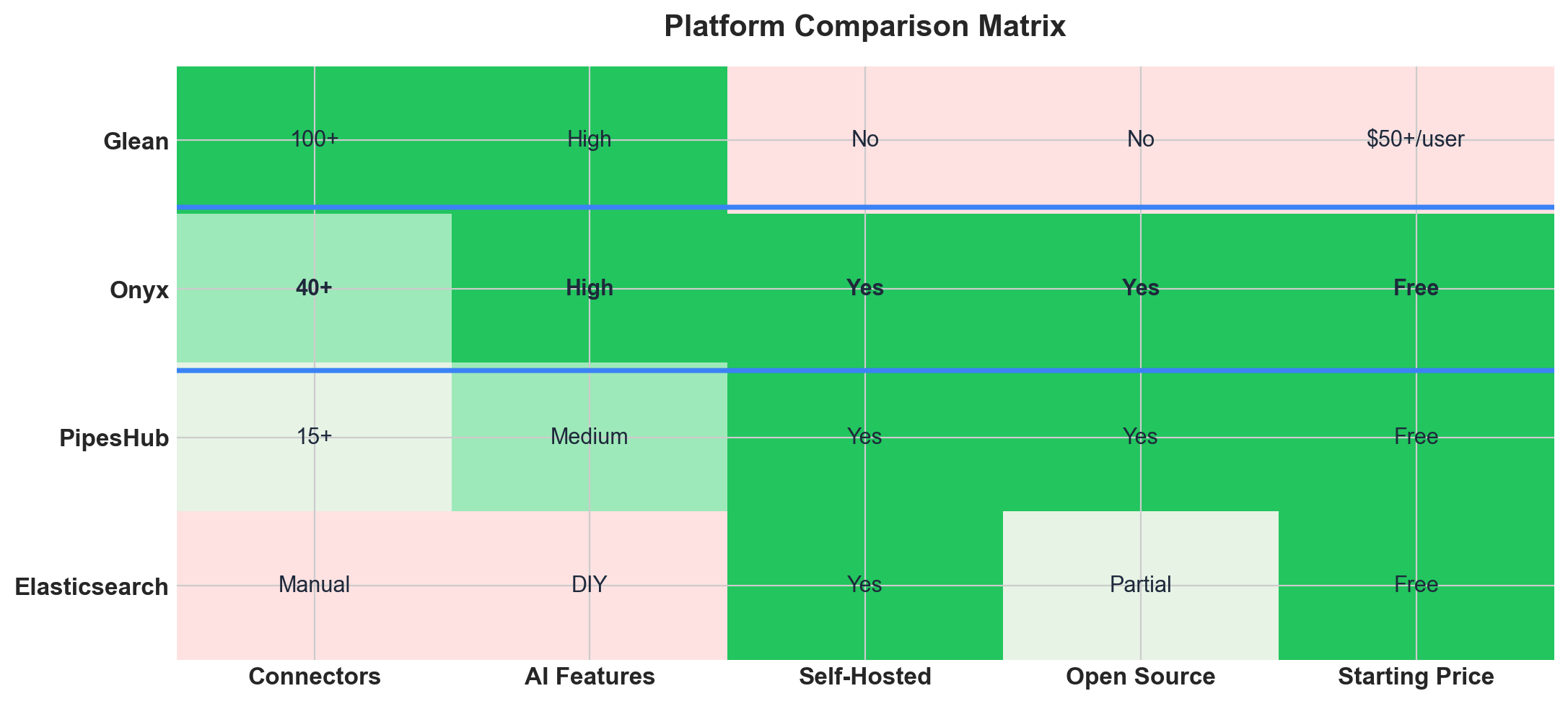
Tools like Elasticsearch, Meilisearch, and Typesense are search engines, not enterprise search platforms. They lack connectors, permission inheritance, and AI chat, and require months of engineering work to approach Glean-equivalent functionality. The genuine open-source Glean alternatives in 2026 are platforms: Onyx and PipesHub.
Open-Source Glean Alternatives: Comparison Table
| Feature | Onyx | PipesHub | Elasticsearch | Meilisearch | Typesense |
|---|---|---|---|---|---|
| Primary Use Case | Enterprise AI search + chat + agents | Enterprise search + workflow automation | Search infrastructure (DIY) | Application search | Application search |
| Open Source | Yes (MIT) | Yes (Open source) | Partial (AGPL core) | Yes (MIT) | Yes (GPL-3) |
| Self-Hosted | Yes | Yes | Yes | Yes | Yes |
| Enterprise Connectors | 40+ (Slack, Jira, Confluence, Google Drive, etc.) | Google Workspace, M365, Slack, Jira, Confluence (growing) | None built-in (build your own) | None built-in | None built-in |
| AI Chat Interface | Yes (multi-model) | Yes | No | No | No |
| Permission Inheritance | Yes | Yes | No | No | No |
| AI Agents | Yes (MCP, OpenAPI, code execution) | Workflow automation | No | No | No |
| Deep Research | Yes | No | No | No | No |
| BYO LLM | Yes (any cloud or local model) | Yes (model-agnostic) | N/A | Limited | Limited |
| Air-Gapped Support | Yes | TBD | Yes | Yes | Yes |
| Cloud Option | Yes ($20/user/month annual, $25/user/month monthly) | TBD | Yes ($95+/mo) | Yes ($30+/mo) | Yes (resource-based) |
| Enterprise Pricing | Contact sales (self-hosted) | Contact sales | $360K+/yr (Platinum, 30 nodes) | $300+/mo (Pro) | $700+/mo (Enterprise support) |
| Free Tier | Yes (full community) | Yes (open source) | Yes (basic) | Yes (open source) | Yes (open source) |
| GitHub Stars | 17,000+ | ~1,000+ | 73,000+ | 49,000+ | 22,000+ |
Detailed Reviews
1. Onyx: The Strongest Open-Source Glean Alternative
Best for: Teams that want a direct, full-featured Glean replacement they can self-host, with enterprise search, AI chat, agents, and deep research included.
Website: onyx.app
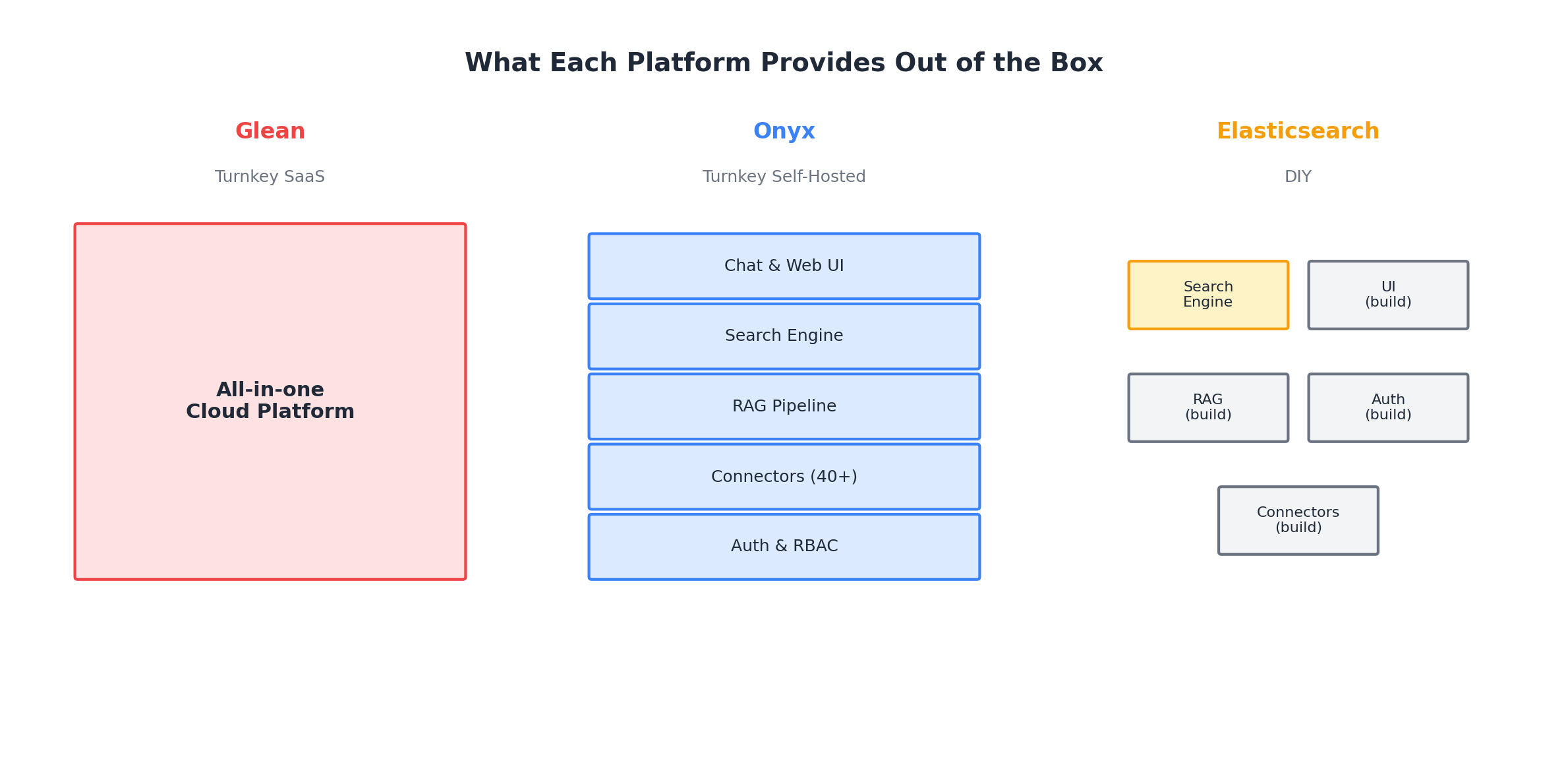
Onyx is an open-source AI platform for work that combines enterprise search, multi-model AI chat, deep research, and custom agents in a single, self-hostable platform. Think of it as ChatGPT Enterprise meets Glean, but open-source, self-hostable, and model-agnostic.
What makes Onyx the top Glean alternative:
- 40+ data source connectors including Slack, Confluence, Jira, Google Drive, SharePoint, Salesforce, GitHub, Notion, HubSpot, and more, with real-time sync and permission inheritance from source systems
- Multi-model AI chat: use OpenAI, Anthropic, Google, DeepSeek, Llama, Mistral, or any model through local inference (Ollama, vLLM, LM Studio)
- Deep research: agentic, multi-step research over internal documents, a feature Glean doesn't offer
- Custom AI agents with MCP tool use, OpenAPI actions, code execution, and web search
- Slack and Teams bots that bring AI-powered answers into the channels your team already uses
- Enterprise security: SOC 2 Type II certified, GDPR compliant, fine-grained RBAC, SSO (OIDC/SAML), and full air-gapped deployment support
Pricing: Free (self-hosted community), $20/user/month (cloud, annual billing), contact sales for enterprise self-hosted. That's roughly 40-60% less than Glean at every scale.
Trade-offs vs. Glean: Onyx has 40+ connectors vs. Glean's 100+. Glean also has a more mature enterprise sales motion and broader brand recognition among Fortune 500 buyers. That said, for any organization that requires self-hosting, code auditability, model choice, or cost control, Onyx delivers capabilities Glean can't match.
Onyx serves over 1,000 enterprise customers, including Netflix, Relativity Space, Thales, and UC San Diego. Approximately 85% of its identifiable enterprise revenue comes from self-hosted deployments, a signal that self-hosting is the core product.
2. PipesHub: The Emerging Open-Source Contender
Best for: Early adopters who want an open-source enterprise search platform with a knowledge graph architecture and are comfortable with a newer, less mature product.
Website: pipeshub.com
PipesHub positions itself as "The Open Source Glean Alternative" and is building a modular, extensible workplace AI platform for enterprise search and workflow automation. Its architecture centers on a knowledge graph that structures all indexed data for more contextual search and AI-driven workflows.
Key features:
- Connectors for Google Workspace, Microsoft 365, Slack, Jira, Confluence, with more planned
- Source-level permission enforcement
- Model-agnostic design (OpenAI, Claude, Ollama, local LLMs)
- Both on-premise and cloud deployment support
- Natural language search across connected apps
- OCR support for PDFs and document images
Trade-offs: PipesHub is earlier-stage than Onyx, with a smaller connector library, a smaller community, and fewer production enterprise deployments. It doesn't yet offer deep research, code interpreter, or an AI chat interface comparable to Onyx or Glean. Still worth watching as the project matures.
3. Elasticsearch: Search Infrastructure for DIY Teams
Best for: Engineering teams with Elasticsearch expertise who want to build a custom enterprise search solution from the ground up.
Website: elastic.co
Elasticsearch is the widely deployed search engine that powers search infrastructure at large scale. It offers powerful full-text search, aggregations, and analytics. But it's search infrastructure, not an enterprise search product.
Key features:
- Proven at scale (millions of queries per second)
- Self-hosted or cloud deployment
- Rich query DSL with advanced relevance tuning
- Open-source core (AGPL license; advanced features require paid license)
- Large ecosystem of tools and documentation
Trade-offs: Elasticsearch gives you a search engine, not an enterprise search platform. There are no built-in connectors for Slack, Confluence, or Google Drive. There's no AI chat interface, no permission inheritance, no agents, and no RAG pipeline. Building a Glean-like experience on Elasticsearch requires months of engineering work, custom connector development, and ongoing maintenance. Elastic's Enterprise Search product (which added some of these features) has been declared end-of-life.
Pricing: The open-source core is free. Self-managed Platinum licensing for a typical mid-market deployment (~30 nodes) runs approximately $360,000/year. Elastic Cloud starts at $95/month.
4. Meilisearch: Fast Application Search
Best for: Developer teams building customer-facing or internal search for applications, not a full enterprise AI platform.
Website: meilisearch.com
Meilisearch is a fast, open-source search engine designed for instant search experiences. It delivers results in under 50ms with built-in typo tolerance, and it's added hybrid search capabilities combining keyword and vector search.
Key features:
- Sub-50ms search latency
- Hybrid search (keyword + semantic vector search)
- Easy to deploy and configure
- MIT-licensed open-source core
- Cloud plans from $30/month
Trade-offs: Meilisearch is an application search engine, not an enterprise knowledge platform. It doesn't have SaaS app connectors, permission systems, AI chat, agents, or a RAG pipeline. You'd need to build data ingestion, permissions, and AI features yourself. It's better suited for powering search within a product (e-commerce, documentation sites) than replacing Glean for internal enterprise search.
5. Typesense: Developer-Friendly Search Engine
Best for: Teams building fast, typo-tolerant search features into their own applications.
Website: typesense.org
Typesense is an open-source (GPL-3) search engine built in C++ for extreme speed, with built-in typo tolerance, faceting, and more recently, conversational search and RAG capabilities.
Key features:
- Sub-50ms search performance
- Built-in typo tolerance and synonyms
- Conversational search (built-in RAG)
- Image and voice search support
- Raft-based distributed clustering for high availability
Trade-offs: Like Meilisearch, Typesense is a search engine, not an enterprise search platform. It lacks SaaS connectors, enterprise permission inheritance, AI chat, or agent capabilities. Its conversational search feature adds some RAG capability, but it isn't comparable to a full enterprise AI platform like Onyx or Glean.
TCO Comparison: Glean vs. Onyx at Scale
Below is an illustrative total cost of ownership comparison for Glean vs. Onyx across three team sizes. Glean does not publish pricing, so these figures are estimates based on customer-reported data from G2 reviews and public sales disclosures. Actual Glean costs vary by contract, seat count, and negotiation.
Assumptions
- Glean: ~$50/user/month (mid-range of reported customer pricing). Glean pricing is not public; this reflects commonly reported contract values, not a guaranteed rate.
- Onyx Cloud: $20/user/month (annual plan)
- Onyx Self-Hosted (Enterprise): Contact sales for pricing + estimated infrastructure costs ($500-2,000/month depending on scale)
- Onyx Self-Hosted (Community): Free software + infrastructure costs + internal engineering time
| 100 Users | 500 Users | 2,000 Users | |
|---|---|---|---|
| Glean (Year 1, estimated) | ~$60,000 | ~$300,000 | ~$1,200,000 |
| Glean (3-Year Total, estimated) | ~$200,000+ | ~$975,000+ | ~$3,900,000+ |
| Onyx Cloud (Year 1) | $24,000 | $120,000 | $480,000 |
| Onyx Cloud (3-Year Total) | $72,000 | $360,000 | $1,440,000 |
| Onyx Self-Hosted Enterprise (Year 1) | Contact sales + infra | Contact sales + infra | Contact sales + infra |
| Onyx Community (Year 1) | $0 + infra + eng time | $0 + infra + eng time | $0 + infra + eng time |
| Estimated savings vs. Glean (Onyx Cloud) | ~60% | ~60% | ~60% |
Glean figures are estimates based on publicly reported customer data. Your actual Glean pricing may differ.
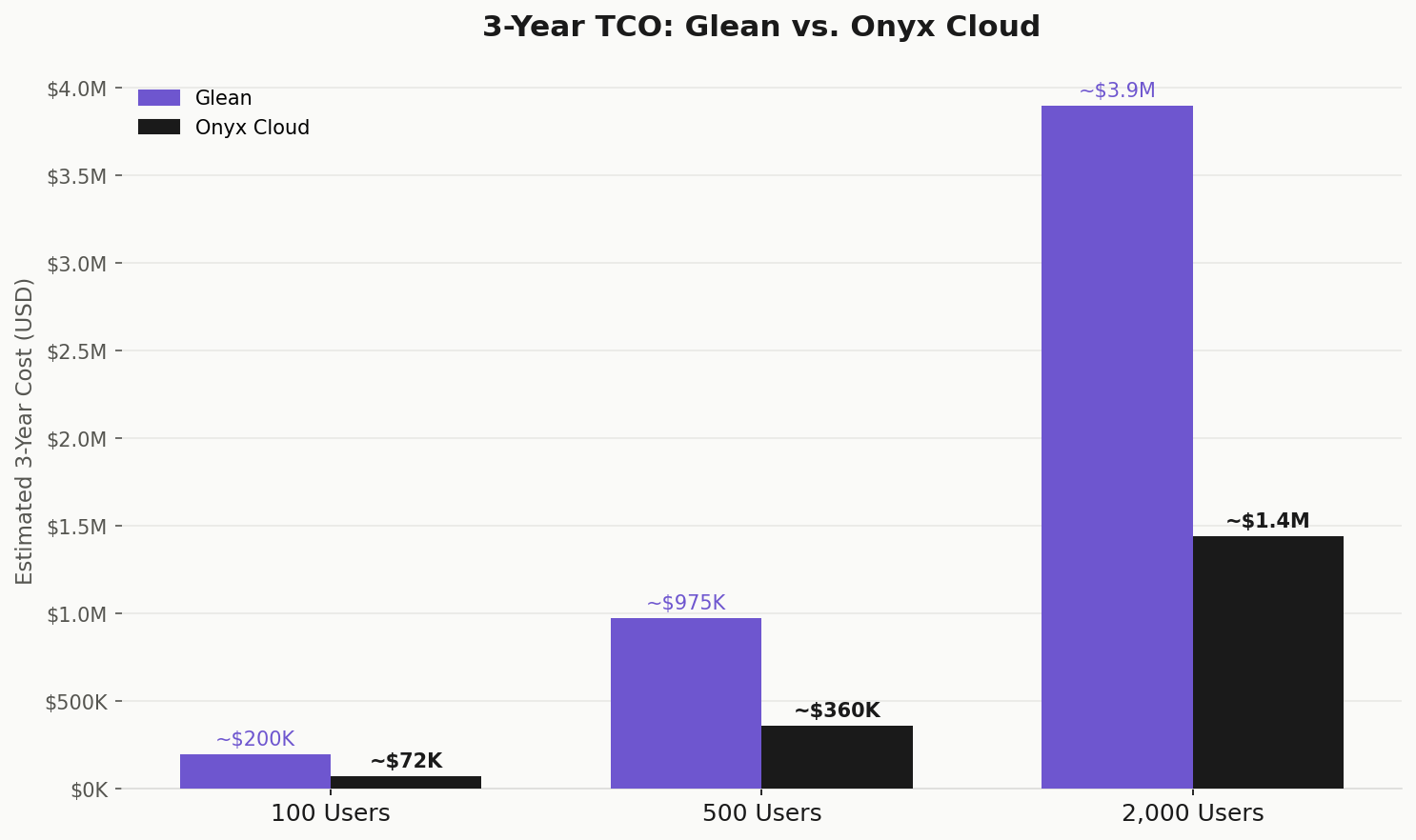
At typical reported Glean pricing, a 500-user organization could save approximately $600,000 over three years by choosing Onyx Cloud.
Which Glean Alternative Is Right for You?
| Your Situation | Best Choice |
|---|---|
| You need a full Glean replacement with enterprise search, AI chat, and agents, and want to self-host | Onyx |
| You are in a regulated industry (defense, healthcare, finance, EU) and need air-gapped or on-premise deployment | Onyx |
| You want the lowest TCO with a free, fully functional community edition | Onyx (Community) |
| You want a managed cloud experience at a fraction of Glean's price | Onyx (Cloud) |
| You want an emerging open-source platform with a knowledge graph architecture | PipesHub (but evaluate maturity) |
| You have a strong engineering team and want to build custom search infrastructure | Elasticsearch |
| You need fast application search for a product or website, not internal enterprise search | Meilisearch or Typesense |
| You need 100+ connectors and budget isn't a constraint | Glean (it's still a strong product) |
Recommendation
Glean built a strong enterprise search product, but its pricing, cloud-only deployment, and closed-source codebase create real barriers for a large segment of the market. For organizations that need an open-source enterprise search platform they can self-host, audit, and control (with AI chat, agents, deep research, and 40+ connectors included), Onyx is the most capable and production-ready alternative available in 2026.
At $20/user/month (cloud) vs. $50+/seat for Glean, the cost difference is obvious. But the bigger draw for most buyers we've spoken to is control: where your data lives, which models power your AI, and how deeply you can customize the platform. If Glean's connector count (100+) is the deciding factor for your team, it's still a strong product. For everyone else, Onyx is the clear pick.
Recommended Setup for Replacing Glean
| Team situation | Recommended setup | Why it works |
|---|---|---|
| Fast evaluation | Onyx Cloud with 3-5 core connectors | Proves answer quality and adoption before a large migration |
| Regulated enterprise | Onyx Enterprise self-hosted with SSO, SCIM, RBAC, and audit logs | Keeps indexed data and model traffic inside controlled infrastructure |
| Air-gapped team | Onyx self-hosted with local LLM inference through vLLM or Ollama | Removes external API dependencies while preserving search and chat |
| Cost-driven migration | Start with Onyx Cloud, then evaluate self-hosting for high-volume teams | Reduces seat cost immediately while keeping a path to deeper control |
A practical migration usually starts with the highest-value sources first: Slack, Google Drive or SharePoint, Confluence, Jira, and GitHub. Run Onyx and Glean side by side for 2-4 weeks, compare answer quality on real employee questions, then expand connector coverage once the core workflows are validated.
Frequently Asked Questions
What is the best open-source Glean alternative in 2026?
Onyx is the strongest open-source Glean alternative available in 2026. It offers enterprise search across 40+ connected apps, AI chat grounded in company data, custom AI agents with MCP tool use, deep research, and self-hosted deployment, all MIT-licensed. At $20/user/month (cloud) or free (community self-hosted), it costs 60-70% less than Glean. Onyx is in production at Netflix, Ramp, Thales, Nebius, UC San Diego, and 1000+ others.
Can Glean be self-hosted?
Not in any meaningful sense. Glean offers a "Customer-Hosted" (cloud-prem) deployment model where Glean deploys and operates the product inside an isolated VPC in your cloud environment. The infrastructure lives in your account, but Glean retains full control: their documentation explicitly states they do not support customers manually deploying, patching, or altering any part of the Glean architecture. You get data residency, but you do not get control, customization, or the ability to audit the running software. For organizations that need genuine self-hosting, where your team owns, operates, and can modify the stack, Glean's cloud-prem option is not sufficient. Onyx, by contrast, is MIT-licensed and fully self-hostable with no Glean-equivalent managed dependency.
How much does Glean cost?
Glean does not publish pricing publicly. Based on customer-reported G2 reviews and sales disclosures, Glean typically costs $45-65+ per user per month, with minimum annual contracts starting at $50,000-60,000. A 100-user deployment runs approximately $50,000-70,000 in year one. A 500-user organization can expect $300,000-400,000 annually, rising by 7-12% at renewal. By comparison, Onyx Cloud costs $20/user/month (annual), and the community edition is free to self-host.
What is Onyx and how does it compare to Glean?
Onyx is an open-source AI platform for work that combines enterprise search, AI chat, custom agents, and deep research in a single self-hostable platform. Key differences from Glean: Onyx is MIT-licensed and fully open-source, while Glean is proprietary. Onyx gives you genuine infrastructure control: you can self-host, air-gap, modify, and audit the full stack. Glean offers a cloud-prem option that runs in your VPC, but the software is still deployed and operated by Glean, so you don't get code access or customization. Onyx is model-agnostic with support for 100+ LLMs; Glean controls which models power its features. Onyx starts at $20/user/month vs. Glean's $45-65+/user/month. Glean has more native connectors (100+ vs. Onyx's 40+) and stronger brand recognition in large enterprise accounts.
Which open-source enterprise search tools support AI agents?
Among open-source enterprise search platforms, Onyx is the only option in 2026 that ships AI agents as a built-in feature. Onyx agents support MCP tool use, OpenAPI actions, code execution, web search, and multi-step deep research. PipesHub offers workflow automation capabilities that are moving toward agent functionality. Elasticsearch, Meilisearch, and Typesense are search infrastructure tools with no agent capabilities.
What open-source enterprise search tools work in air-gapped environments?
Onyx is the leading open-source enterprise search platform with confirmed air-gapped deployment support. It can run fully offline using locally-hosted LLMs (via Ollama, vLLM, or LM Studio) and local vector infrastructure, with no external API dependencies required. Elasticsearch also supports air-gapped deployments, but requires significant engineering to build AI chat, connectors, and permission inheritance on top of it. PipesHub's air-gapped support is in progress.
Related Insights
How Onyx's RAG Engine Cuts Token Usage at Enterprise Scale (2026)
Agents that read every source burn tokens on every task. Learn how Onyx's RAG engine indexes your sources once, condenses them into a vector DB, and serves enterprise context in one cheap retrieval call.

Self-Hosted RAG in 2026: The Complete Guide to Running Retrieval-Augmented Generation On Your Own Infrastructure
How to deploy retrieval-augmented generation on your own infrastructure. Compare self-hosted RAG platforms (Onyx, Open WebUI, LibreChat, AnythingLLM, RAGFlow, Verba) and frameworks (LlamaIndex, LangChain, Haystack), with recommended stacks for small, mid-market, and air-gapped enterprise deployments.
Best Enterprise RAG Platforms for 2026: A Buyer's Guide
Compare 11 enterprise RAG platforms across architecture, connectors, deployment, security, and pricing. Includes turnkey, cloud, and open-source options with current 2026 pricing and analyst data.